
UPCOMING COUNCIL MEETING
Delta staff are preparing a report to Council, anticipated to be brought forward in the coming months, to outline the results of the November 2025 public consultation sessions, and seek direction from Council on next steps. Please keep an eye on this space for more information in the near future.
Supporting Gradual Change in Delta Neighbourhoods
Every city has a Zoning Bylaw that regulates what can be built on different types of properties. In response to new provincial requirements, local governments were directed to amend their bylaws to permit small-scale, multi-unit housing (SSMUH) —such as secondary suites, coach houses, and garden suites. The Province has since asked Delta to review our Zoning Bylaw to further align with Provincial Site Standards. Delta has proposed five key changes to its Zoning Bylaw to address provincial direction, and to ensure new development provides livable space and fits in established neighbourhoods.
1. Add Houseplexes as a Permitted Use
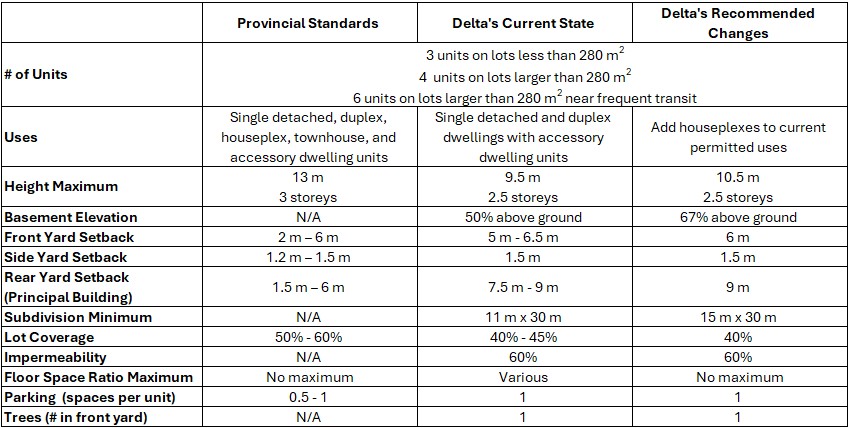
Delta is proposing to add houseplexes as a permitted use. A houseplex is a building with three or four main dwelling units on one lot, each with its own exterior entrance. Secondary suites are not permitted in a houseplex. Houseplexes provide more options for multi-unit living within established neighbourhoods.
2. Increase Height By 1 Metre
Delta is proposing to increase the maximum height for buildings with sloped roofs from 9.5 to 10.5 metres. This change would not add extra storeys but would allow for shallower, brighter basements with larger windows. It also reduces excavation and pumping costs associated with deeper basements.
3. Remove Floor Space Ratio (FSR) Regulations
FSR rules determine how much building floor area you’re allowed to construct on your property. In Delta, the current rules include many exceptions—such as extra space for garages, basements, and accessory buildings—which makes calculating the total allowed floor area quite complicated. Delta is proposing to remove the FSR cap as other rules — such as height limits and setbacks — already control the overall size of buildings. Removing FSR simplifies the development process, offers more design flexibility, and ensures homes remain appropriately scaled to their lots and surroundings.
4. Standardize Small Scale Residential Zones
Delta currently has 12 small-scale residential zones with only minor differences, creating unnecessary complexity for property owners and staff. The City is proposing to consolidate and standardize these zones to simplify regulations, reduce permitting steps, and make it easier to build the types of housing most in demand.
5. Increase Minimum Lot Dimensions For Subdivision
To support livable unit designs, Delta is proposing to increase the minimum frontage for new lots from 11 to 15 metres, while maintaining a 30-metre depth. This ensures future subdivisions result in well-proportioned lots that can accommodate comfortable, functional homes.
Here are some of the more technical aspects of what the Province is recommending, what Delta's Zoning Bylaw currently says, and what is being proposed by Delta now.
What Does It Mean For You?
If you’re interested in developing your property:
You will have more flexibility to build what you need under clearer, standardized rules with less administration. The changes would also reduce excavation and servicing costs for basement secondary suites.
If you’re interested in your neighbourhood:
The added density may bring some gradual change, but by maintaining existing setbacks, increasing lot frontage, and proposed height limits, the City aims to ensure new development fits comfortably within established neighbourhoods.
ARCHIVE
CLOSED: This survey has concluded.
SSMUH Feedback Form (June 2025)
THIS FORM IS CLOSED. PLEASE FOLLOW THIS LINK(External link) TO COMPLETE THE CURRENT FEEDBACK FORM.
Staff are monitoring the progress of SSMUH in Delta and will be reporting back to Council in 2025. Staff would like to hear from residents about SSMUH in Delta. Please fill out the form below to share your feedback and help inform future zoning bylaw updates. Feedback will be collected through to June 30, 2025 and the findings will be shared with Council at a future meeting.